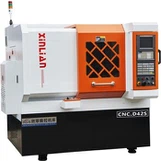
What is CNC mill turn lathe?
A CNC mill-turn lathe, also known as a mill-turn center or multitasking machine, is a type of computer numerical control (CNC) machine that combines the capabilities of both a CNC milling machine and a CNC turning machine in a single unit. This versatile machine tool is capable of performing various machining operations, including milling, drilling, turning, and other processes, all in a single setup.
Specifications
|
CNC-D42S Technical Specifications |
|||
|
Project |
Name |
Specification |
Units |
|
Travel |
X axis |
1000 |
mm |
|
Z axis |
450 |
mm |
|
|
Table |
Size(Length×Width) |
680×200 |
mm |
|
T Slot(No.×Width×Distance) |
3×20×45 |
mm |
|
|
Tool handle specification |
20×20 |
mm |
|
|
Spindle |
Taper hole of spindle |
40 |
Degree |
|
Clamping mode |
Hydraulic/Manual |
||
|
Driving mode |
Belt drive |
||
|
Spindle speed |
50-3000 |
rpm |
|
|
Motor |
Spindle motor |
5.5 |
kW |
|
X spindle motor |
4 |
N·m |
|
|
Z spindle motor |
6 |
N·m |
|
|
Feed |
X axis rapid traverse |
18000 |
mm/min |
|
Z axis rapid traverse |
20000 |
mm/min |
|
|
Accuracy |
Positioning accuracy |
±0.005 |
mm |
|
Repeatability precision |
±0.003 |
mm |
|
|
Other |
Machine weight(about) |
2100 |
kg |
|
Overall dimension(L×W×H) |
1820×1650×1690 |
mm |
|
|
Power capacity |
5 |
kW |
|
Company Profile

Your Premier CNC Mill Turn Lathe Manufacturer!
Zhejiang Hao Feng CNC Technology Co., Ltd. is a high-quality manufacturer with 30 years of production experience. The company mainly produces: series of CNC machine tools, inclined bed linear rail CNC machine tools, turning and milling compound machine tools, CNC special machines, etc. As one of the earliest companies to manufacture machine tools, the company has its own quality inspection workshop and consistently implements the provisions of the ISO9001 quality management system. It is deeply favored by customers in overseas markets.
why choose us
High Quality
Made of high-quality hard cast iron and annealed to eliminate residual stress and ensure the stability and toughness of the material.
One-stop Solution
The company integrates R&D, production and sales to solve all product-related problems for you.
24H Online Service
We have professional sales managers who provide you with online service 24 hours a day.
Quality Control
In strict accordance with international standards, each process is inspected during the production process to ensure compliance with standards.
Features of CNC Mill Turn Lathe
The features of a CNC mill-turn lathe include a combination of capabilities from both CNC milling machines and CNC turning machines. Here are the key features of a CNC mill-turn lathe:
Multi-axis Machining
A CNC mill-turn lathe is capable of performing machining operations on multiple axes, typically including X, Y, Z for milling and C, and sometimes B for turning. This allows for complex and intricate part geometries to be machined in one setup.
Simultaneous Machining
The CNC mill-turn lathe can perform milling and turning operations simultaneously, which enables efficient production of parts with multiple features and tight tolerances.
Live Tooling
Many CNC mill-turn lathes are equipped with live tooling, which allows the machine to perform additional operations such as drilling, tapping, and milling using rotating cutting tools while the workpiece is stationary.
Integrated Automation
Some mill-turn lathes may have automated features such as automatic tool changers, part probing, and bar feeders to streamline the production process and reduce manual intervention.
Versatility
CNC mill-turn lathes are capable of handling a wide range of materials, including metals, plastics, and composites, making them suitable for various industries and applications.
Reduced Setup Times
By combining multiple machining functions into a single machine, CNC mill-turn lathes help reduce setup times, minimize material handling, and increase overall productivity.
Enhanced Accuracy
The integration of milling and turning capabilities in one machine allows for improved machining accuracy and part quality, as well as better consistency in part dimensions.
Complex Part Capability
The CNC mill-turn lathe is well-suited for manufacturing complex parts with intricate features, such as contoured surfaces, bores, threads, and other challenging geometries.
Advanced Control Systems
These machines are equipped with sophisticated CNC control systems that allow for efficient programming and monitoring of machining operations.
Advantages of CNC Mill Turn Lathe
There are several advantages of a CNC mill-turn lathe that make it a popular choice for manufacturing complex parts. Here are some of the main advantages:
1.Increased Efficiency: The combination of milling and turning capabilities in one machine allows for efficient production of complex parts without having to move the workpiece between multiple machines. This reduces setup times, minimizes material handling, and increases overall productivity.
2.Improved Accuracy: The integration of milling and turning capabilities in one machine allows for improved machining accuracy and part quality, as well as better consistency in part dimensions. This makes CNC mill-turn lathes ideal for producing parts with tight tolerances.
3.Reduced Cycle Times: By performing multiple operations simultaneously, CNC mill-turn lathes can significantly reduce cycle times, leading to faster production rates and shorter lead times.
4.Versatility: CNC mill-turn lathes are capable of handling a wide range of materials, including metals, plastics, and composites, making them suitable for various industries and applications.
5.Complex Part Capability: The CNC mill-turn lathe is well-suited for manufacturing complex parts with intricate features, such as contoured surfaces, bores, threads, and other challenging geometries.
6.Cost-effectiveness: The use of a single machine for multiple operations reduces the need for additional equipment, tooling, and labor costs, making CNC mill-turn lathes a cost-effective solution for producing complex parts.
7.Automation: Many CNC mill-turn lathes are equipped with automated features such as automatic tool changers, part probing, and bar feeders, which streamline the production process and reduce manual intervention.
8.Advanced Control Systems: CNC mill-turn lathes are equipped with sophisticated CNC control systems that allow for efficient programming and monitoring of machining operations, leading to increased precision and efficiency.
What are the components of CNC Mill Turn Lathe?
A CNC mill-turn lathe consists of several components that work together to perform milling and turning operations. Here are the key components of a typical CNC mill-turn lathe:
Bed: The bed is the base of the machine, providing a rigid and stable platform for all other components. It is usually made of cast iron or steel to ensure stability and minimize vibrations during machining.
Headstock: The headstock houses the main spindle, which rotates the workpiece during turning operations. It also contains the gearbox and motor that drive the spindle at various speeds.
Tailstock: The tailstock is located opposite the headstock and provides support for long workpieces. It can be moved along the bed to accommodate different part lengths and can be locked in position for stability.
Tool Turret: The tool turret holds the cutting tools used for milling and turning operations. It is typically mounted on a rotating disc or a linear slide and can automatically change tools as programmed by the CNC control system.
Live Tooling: Some CNC mill-turn lathes are equipped with live tooling, which consists of additional tool holders and motors mounted on the turret. Live tools enable the machine to perform milling, drilling, and other operations while the workpiece is stationary.
Spindle Motors: The machine is equipped with spindle motors that provide power for both milling and turning operations. These motors are controlled by the CNC system to achieve the desired speed and torque for each operation.
CNC Control System: The CNC control system is the brain of the machine, responsible for programming, monitoring, and controlling all aspects of the machining process. It receives instructions from the operator or pre-programmed code and sends commands to the motors, tool turret, and other machine functions.
Workholding Devices: Various workholding devices are used to secure the workpiece during machining. These can include chucks, collets, fixtures, and vices, depending on the type and size of the workpiece.
Coolant System: A coolant system is used to lubricate and cool the cutting tools during machining, reducing heat and prolonging tool life. It also helps to flush away chips and debris from the cutting zone.
Application of CNC Mill Turn Lathe
CNC mill-turn lathes have a wide range of applications across various industries. Here are some common applications of CNC mill-turn lathes:
1. Aerospace Industry
CNC mill-turn lathes are extensively used in the aerospace industry for producing complex components such as turbine blades, engine parts, landing gear components, and structural elements. The ability to perform both turning and milling operations in a single machine is particularly beneficial for manufacturing intricate aerospace parts.
2. Automotive Industry
CNC mill-turn lathes play a vital role in the production of automotive components, including engine parts, transmission components, drive shafts, brake system components, and suspension parts. The machines' multitasking capabilities and high precision make them ideal for manufacturing critical automotive parts with tight tolerances.
3. Medical Industry
CNC mill-turn lathes are used in the medical field for producing various medical devices and implants. These include orthopedic implants, prosthetics, dental components, surgical instruments, and other precision medical parts. The machines' ability to produce complex geometries and high-quality finishes is crucial in the medical industry.
4. Oil And Gas Industry
CNC mill-turn lathes are employed in the oil and gas sector for manufacturing components such as valves, connectors, flanges, and drilling equipment. These machines can handle a wide range of materials, including alloys and exotic metals, making them suitable for the demanding requirements of the oil and gas industry.
5. Electronics Industry
CNC mill-turn lathes are utilized in the electronics industry for producing connectors, terminals, housings, and other precision electronic components. These machines enable manufacturers to efficiently machine complex features, such as threads and small details, ensuring the precise fit and functionality of the electronic parts.
6. General Engineering
CNC mill-turn lathes find application in general engineering, where they are used for producing a variety of components, such as shafts, bushings, fittings, gears, and other custom parts. The machines' versatility, accuracy, and efficiency make them valuable assets in general engineering workshops.
7. Defense Industry
CNC mill-turn lathes are used by defense contractors for manufacturing military components, including weapon systems, ammunition casings, missile components, and defense equipment. The machines' capability to handle high-strength materials and produce complex shapes is vital in the defense industry.
Our Equipment


FAQ
Q: What is a CNC mill-turn lathe?
A: A CNC mill-turn lathe is a machine tool that combines the capabilities of a CNC milling machine and a CNC lathe, allowing it to perform both turning and milling operations on a workpiece.
Q: What are the advantages of using a CNC mill-turn lathe?
A: The advantages include reduced setup time, increased productivity, improved accuracy, enhanced versatility, and the ability to produce complex parts in a single setup.
Q: What types of materials can be machined on a CNC mill-turn lathe?
A: CNC mill-turn lathes can machine a wide range of materials, including metals such as steel, aluminum, brass, titanium, and alloys, as well as plastics and composites.
Q: What is the difference between a CNC mill-turn lathe and a traditional lathe?
A: A CNC mill-turn lathe offers greater flexibility and automation compared to a traditional lathe. It can perform milling, drilling, and other operations in addition to turning, and it is controlled by computer numerical control (CNC) technology.
Q: Can a CNC mill-turn lathe handle both small and large workpieces?
A: Yes, CNC mill-turn lathes come in various sizes and can accommodate both small and large workpieces, depending on the specific machine model.
Q:
A: How does tool changing work on a CNC mill-turn lathe?7.A CNC mill-turn lathe typically has a tool turret that holds multiple tools. Tool changes are automated and controlled by the CNC system, allowing for efficient and quick tool switching during operations.
Q: What is live tooling on a CNC mill-turn lathe?
A: Live tooling refers to the capability of a CNC mill-turn lathe to have rotating cutting tools mounted on the turret. This allows for simultaneous milling and turning operations, expanding the machine's capabilities.
Q: Can a CNC mill-turn lathe perform 5-axis machining?
A: Yes, some advanced CNC mill-turn lathes have 5-axis capability, enabling them to perform complex machining operations from multiple angles.
Q: How accurate are CNC mill-turn lathes?
A: CNC mill-turn lathes can achieve high levels of accuracy, typically within a few thousandths of an inch or even tighter, depending on the machine's capabilities and the setup.
Q: What programming language is used for CNC mill-turn lathes?
A: CNC mill-turn lathes are typically programmed using G-code, which is a standardized programming language for CNC machines.
Q: Can a CNC mill-turn lathe produce threads?
A: Yes, CNC mill-turn lathes can produce threads by using specialized threading tools or through thread milling operations.
Q: What are some safety considerations when operating a CNC mill-turn lathe?
A: Safety considerations include wearing appropriate personal protective equipment, ensuring proper machine guarding, following safe operating procedures, and being aware of potential hazards associated with rotating parts, cutting tools, and coolant systems.
Q: Can a CNC mill-turn lathe be automated with a robotic system?
A: Yes, CNC mill-turn lathes can be integrated with robotic systems for automation, allowing for unmanned operation and increased production efficiency.
Q: How is the quality of the machined parts ensured on a CNC mill-turn lathe?
A: Quality assurance on a CNC mill-turn lathe involves regularly checking and calibrating the machine, using accurate measuring instruments, conducting in-process inspections, and adhering to quality control processes.
Q: Can a CNC mill-turn lathe be used for prototyping?
A: Yes, CNC mill-turn lathes are commonly used for prototyping, as they offer the flexibility to quickly iterate designs and produce functional prototypes with precision.
Q: What maintenance is required for a CNC mill-turn lathe?
A: Regular maintenance tasks include lubrication, cleaning, checking and replacing worn parts, calibrating the machine, and keeping the cutting tools in good condition.
Q: Can a CNC mill-turn lathe be used for batch production?
A: Yes, CNC mill-turn lathes are well-suited for batch production as they can efficiently machine multiple parts in a single setup, reducing setup time and increasing productivity.
Q: Can a CNC mill-turn lathe be connected to a computer network?
A: Yes, many modern CNC mill-turn lathes can be connected to a computer network, allowing for data transfer, program updates, and remote monitoring and control.
Hot Tags: CNC mill turn lathe, China, suppliers, manufacturers, customized, quotation, low price, made in China