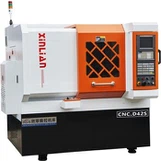
What is high precision CNC machine?
A high precision CNC machine refers to a computer numerical control (CNC) machine that is designed to achieve extremely accurate and precise machining operations. These machines utilize advanced technologies, components, and control systems to ensure minimal error and tight tolerances during the manufacturing process.
Products Specifications
|
XC-0632S/0640S Technical Specifications |
|||
|
Project |
Name |
Specification |
Units |
|
Travel |
X axis |
420(Diameter) |
mm |
|
Y axis |
320 |
mm |
|
|
Table |
Table size(L×W) |
420×180 |
mm |
|
T Slot(No.×Width×Distance) |
3×20×45 |
mm |
|
|
Tool shank size |
20×20 |
mm |
|
|
Spindle |
Taper hole of spindle |
40(With ¢43/44 collet) |
Degree |
|
40(With ¢54/56 collet) |
Degree |
||
|
Clamping mode |
Pneumatic/Hydraulic pressure |
||
|
Driving mode |
Belt drive |
||
|
Spindle speed |
50-4000 |
rpm |
|
|
Motor |
Spindle motor |
3/4 |
kW |
|
X spindle motor |
4 |
N·m |
|
|
Z spindle motor |
4 |
N·m |
|
|
Feed |
X axis rapid traverse |
12000 |
mm/min |
|
Z axis rapid traverse |
15000 |
mm/min |
|
|
Accuracy |
Positioning accuracy |
±0.008 |
mm |
|
Repeatability precision |
±0.005 |
mm |
|
|
Other |
Machine weight(about) |
950 |
mm |
|
Overall dimension(L×W×H) |
1380×1100×1520 |
mm |
|
|
Power capacity |
7 |
kW |
|
Your Professional High Precision CNC Machine Manufacturer!
Zhejiang Hao Feng CNC Technology Co., Ltd. is a high-quality manufacturer with 30 years of production experience. The company mainly produces: series of CNC machine tools, inclined bed linear rail CNC machine tools, turning and milling compound machine tools, CNC special machines, etc. As one of the earliest companies to manufacture machine tools, the company has its own quality inspection workshop and consistently implements the provisions of the ISO9001 quality management system. It is deeply favored by customers in overseas markets.

Why choose us?
High Quality
Made of high-quality hard cast iron and annealed to eliminate residual stress and ensure the stability and toughness of the material.
One-stop Solution
The company integrates R&D, production and sales to solve all product-related problems for you.
24H Online Service
We have professional sales managers who provide you with online service 24 hours a day.
Quality Control
In strict accordance with international standards, each process is inspected during the production process to ensure compliance with standards.
Features of high precision CNC machine
High precision CNC machines are known for their advanced features and capabilities that enable them to achieve exceptional accuracy and tight tolerances. Here are some common features found in high precision CNC machines:
Rigidity And Stability
High precision CNC machines are built with robust structures and high-quality materials to provide excellent rigidity and stability. This minimizes vibrations, deflection, and other sources of mechanical error that can impact precision.
Advanced Control Systems
These machines are equipped with sophisticated control systems that incorporate advanced algorithms and feedback mechanisms. The control systems allow for precise control of motion, velocity, acceleration, and position, ensuring accurate machining operations.
Linear Motion Systems
High precision CNC machines often employ high-precision linear motion systems such as linear guides, ball screws, and high-quality bearings. These components facilitate smooth and precise movement of the machine's axes, minimizing backlash and play.
High-Performance Spindles
The spindle, which holds the cutting tool, is a critical component for achieving high precision. High precision CNC machines feature high-performance spindles with low runout and excellent rotational stability. This ensures precise cutting and surface finishes.
Thermal Stability
Temperature fluctuations can affect the dimensional accuracy of machined parts. To mitigate this, high precision CNC machines may incorporate thermal compensation systems, including temperature sensors and feedback mechanisms. These systems help maintain consistent accuracy even in varying environmental conditions.
Metrology and Inspection Systems
Many high precision CNC machines have built-in metrology and inspection systems. These systems allow for in-process measurement and verification of part dimensions, ensuring that the machined parts meet required specifications.
Advanced Tooling and Tool Measurement
High precision CNC machines often use advanced cutting tool technologies, such as high-performance tool materials, coatings, and geometries. They may also include automatic tool changers and tool measurement systems to ensure accurate tool positioning and compensate for tool wear.
Software Capabilities
High precision CNC machines are compatible with advanced CAD/CAM software. This software allows for the creation of complex machining programs, optimization of cutting paths, and simulation of machining operations before actual production.
Multi-Axis Capability
Many high precision CNC machines have multi-axis capability, including 3-axis, 4-axis, or even 5-axis configurations. This enables simultaneous machining from multiple angles, facilitating the production of complex and contoured parts.
Advantages of high precision CNC machine
High precision CNC machines offer several advantages over conventional machining methods. Here are some of the key advantages:
1.Exceptional Accuracy: High precision CNC machines are designed to achieve extremely tight tolerances, typically in the range of micrometers or even submicrometers. This level of accuracy allows for the production of intricate and complex parts with precise dimensions.
2.Reproducibility: CNC machines operate based on programmed instructions, ensuring consistent and repeatable results. Once a machining program is created, it can be executed multiple times with the same precision, eliminating variations caused by human error.
3.Increased Efficiency: CNC machines are capable of performing automated operations, reducing the need for manual intervention. This improves production efficiency, as machines can operate continuously, performing multiple machining operations without operator supervision.
4.Complex Geometry: High precision CNC machines can produce parts with complex geometries that are challenging or impossible to achieve with conventional machining methods. They can perform simultaneous multi-axis movements, enabling the creation of intricate shapes, contours, and features.
5.Flexibility: CNC machines offer high flexibility in terms of the types of materials they can work with. They can handle a wide range of materials, including metals, plastics, composites, and more. Additionally, they can accommodate various machining processes, such as milling, turning, drilling, and grinding.
6.Improved Quality Control: High precision CNC machines often incorporate built-in metrology and inspection systems. These systems allow for in-process measurement and verification of part dimensions, ensuring that the machined parts meet the required specifications. This helps maintain consistent quality control throughout the production process.
7.Faster Setup and Changeover: CNC machines have the advantage of quick setup and changeover times. Once a machining program is created and the necessary tooling is in place, switching between different parts or production runs is relatively fast and straightforward.
8.Reduction in Scrap and Waste: The accuracy and repeatability of high precision CNC machines contribute to a significant reduction in scrap and waste material. The precise control of cutting tools minimizes errors and ensures optimal material usage, resulting in cost savings and increased efficiency.
9.Integration with CAD/CAM Software: High precision CNC machines can be seamlessly integrated with computer-aided design (CAD) and computer-aided manufacturing (CAM) software. This allows for the creation of complex machining programs, optimization of cutting paths, and simulation of machining operations before actual production. It enhances productivity and helps identify potential issues or collisions in advance.
10.Automation and Lights-Out Operation: High precision CNC machines can be automated and run continuously, even during non-operational hours. This lights-out operation maximizes machine utilization, reduces labor costs, and increases overall productivity.
What products can High precision CNC machines produce?
High precision CNC machines are capable of producing a wide range of products across various industries due to their ability to achieve tight tolerances, intricate geometries, and consistent accuracy. Some of the products that high precision CNC machines can manufacture include:
1
Aerospace Components: High precision CNC machines are used to produce critical aerospace components such as engine parts, turbine blades, aircraft structures, landing gear components, and intricate assemblies that require precise machining and tight tolerances.
2
Medical Devices: CNC machining is utilized in the production of medical devices and components, including surgical implants, orthopedic instruments, dental prosthetics, diagnostic equipment, and specialized medical tools that demand high precision and biocompatible materials.
3
Electronics and Semiconductors: CNC machines are employed in the manufacturing of electronic components, semiconductor parts, precision connectors, printed circuit boards (PCBs), housing enclosures, and microelectronic components that require intricate features and precise dimensions.
4
Automotive Parts: High precision CNC machining is widely used in the automotive industry to fabricate engine components, transmission parts, fuel system components, steering and suspension parts, brake components, and precision gears with strict dimensional requirements.
5
Tooling and Molds: CNC machines are utilized to produce precision tooling, molds for injection molding and die casting, extrusion dies, stamping dies, and other specialized tooling used in manufacturing processes that demand high accuracy and surface finish.
6
Optical Components: High precision CNC machines are employed to manufacture optical components such as lenses, mirrors, prisms, filters, and precision optical mounts used in imaging systems, lasers, telescopes, and scientific instruments.
7
Precision Instruments: CNC machining is used to fabricate components for precision instruments, analytical instruments, laboratory equipment, measuring devices, and testing apparatus that require exacting tolerances and intricate geometries.
8
Customized Prototypes and Small Batch Production: High precision CNC machines are capable of producing customized prototypes, small batches, and low-volume production runs of specialized components, allowing for rapid prototyping and agile manufacturing.
9
Defense and Firearms Components: CNC machining is utilized in the production of defense and firearms components, including weapon parts, sighting systems, tactical equipment, and specialized defense-related components requiring high precision and reliability.
10
Customized Industrial Components: CNC machines are used to fabricate customized industrial components, machine parts, jigs, fixtures, and specialized tooling for diverse industrial applications across sectors such as energy, manufacturing, and automation.
Process of High precision CNC machines
The process of high precision CNC machines involves several steps, from design to the final production of the desired component. Here is a general overview of the process:
Design
The first step is designing the component using computer-aided design (CAD) software. The design includes specifying dimensions, tolerances, and material requirements.
CAM Programming
Once the design is complete, the CAD file is imported into computer-aided manufacturing (CAM) software. CAM programming involves creating the machining instructions, known as G-code, that will guide the CNC machine during the manufacturing process. This includes selecting the appropriate cutting tools, defining cutting paths, and configuring parameters such as spindle speed and feed rates.
Material Preparation
The next step is preparing the raw material for machining. This may involve cutting the material into the desired size or shape using saws or other cutting tools. The material is then securely mounted onto the CNC machine's workholding device, such as a vice, chuck, or fixture.
Machine Setup
Before starting the machining process, the CNC machine needs to be set up. This involves loading the CAM program into the machine's control unit, installing the necessary cutting tools, and ensuring proper alignment and calibration of the machine's axes.
Machining Operations
With the machine set up, the CNC machine starts executing the programmed instructions. Depending on the complexity of the component, multiple machining operations may be performed, such as milling, turning, drilling, boring, tapping, or grinding. The CNC machine precisely controls the movement and positioning of the cutting tool to remove material and shape the component according to the programmed design.
In-Process Inspection
Throughout the machining process, in-process inspections may be conducted to verify the dimensions and quality of the partially machined component. This can be done using built-in metrology systems on the CNC machine or by using separate inspection equipment such as coordinate measuring machines (CMMs) or non-contact measurement devices.
Finishing Operations
After the primary machining operations are complete, additional finishing operations may be performed to achieve the desired surface finish, such as polishing, deburring, or coating.
Final Inspection
Once the component is fully machined and finished, a final inspection is conducted to ensure it meets the required specifications. This may involve dimensional measurements, visual inspections, or functional testing.
FAQ
Q: What is a high precision CNC machine?
A: A high precision CNC machine is a computer-controlled machine tool capable of performing precise machining operations with tight tolerances.
Q: What are the advantages of using high precision CNC machines?
A: High precision CNC machines offer increased accuracy, repeatability, efficiency, and versatility compared to conventional machining methods.
Q: What industries use high precision CNC machines?
A: High precision CNC machines are widely used in industries such as aerospace, automotive, medical, electronics, and manufacturing.
Q: What materials can be machined using high precision CNC machines?
A: High precision CNC machines can machine a variety of materials, including metals (such as aluminum, steel, and titanium), plastics, composites, and more.
Q: What are the main types of high precision CNC machines?
A: The main types of high precision CNC machines include CNC milling machines, CNC turning machines, CNC grinding machines, and CNC drilling machines.
Q: How accurate are high precision CNC machines?
A: High precision CNC machines can achieve accuracies within microns, depending on the machine's design, construction, and calibration.
Q: Can high precision CNC machines perform complex shapes?
A: Yes, high precision CNC machines are capable of machining complex shapes and contours using advanced programming techniques and multi-axis capabilities.
Q: What is the difference between high precision CNC machines and conventional machines?
A: High precision CNC machines are computer-controlled, offering greater automation, accuracy, and flexibility compared to conventional machines operated manually.
Q: How do you program a high precision CNC machine?
A: High precision CNC machines are programmed using computer-aided manufacturing (CAM) software, where operators input machining instructions and tool paths.
Q: How long does it take to machine a part using a high precision CNC machine?
A: The machining time depends on various factors, including part complexity, material, cutting parameters, and machine capabilities. It can range from minutes to several hours.
Q: Can high precision CNC machines perform multi-axis machining?
A: Yes, high precision CNC machines can perform multi-axis machining, including 3-axis, 4-axis, and 5-axis operations, enabling complex geometries and angles.
Q: What is the role of coolant in high precision CNC machines?
A: Coolant is used in high precision CNC machines to lubricate cutting tools, reduce friction, remove heat, and flush away chips, improving tool life and surface finish.
Q: How do high precision CNC machines ensure tool accuracy and longevity?
A: High precision CNC machines employ tool measurement and compensation systems to monitor tool wear, automatically adjust tool offsets, and maintain accuracy.
Q: Are high precision CNC machines suitable for small-scale production?
A: Yes, high precision CNC machines are commonly used in small-scale production as they offer fast setup times, high productivity, and excellent repeatability.
Q: Can high precision CNC machines be automated for unmanned operation?
A: Yes, high precision CNC machines can be integrated with robotic systems, loading/unloading mechanisms, and pallet changers for unmanned or lights-out operation.
Q: What safety precautions should be taken when operating high precision CNC machines?
A: Operators must follow safety guidelines, such as wearing appropriate personal protective equipment (PPE), securing workpieces, and following machine-specific safety protocols.
Hot Tags: high precision CNC machine, China, suppliers, manufacturers, customized, quotation, low price, made in China